
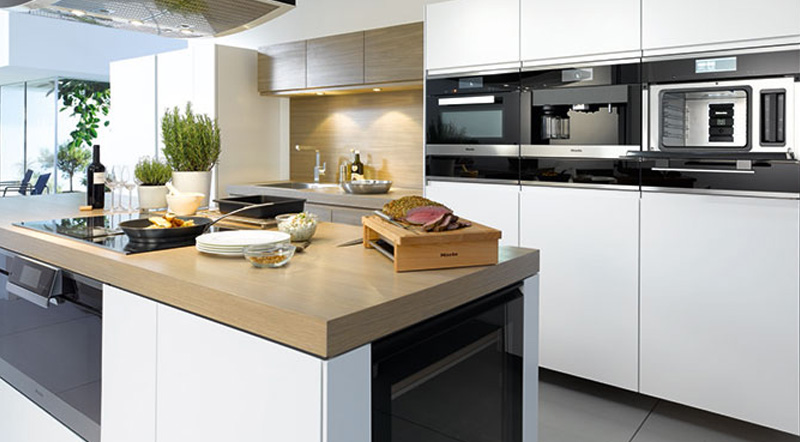
Integrated appliances can make a kitchen look calm, but they need to be planned as part of the furniture. The useful question is not simply which oven or dishwasher looks best. It is whether the chosen model can be fitted, opened, used, maintained and eventually replaced in the cabinets being ordered.
Start with the jobs you need the appliances to do. A household that cooks every evening may value a different oven arrangement from one that mainly uses the kitchen for quick meals. Think about what needs to be stored cold, how often the dishwasher runs and whether laundry belongs in this room. Make a shortlist of functions before choosing finishes or brand names.
Settle models before fixing cabinet sizes
“Integrated” does not mean interchangeable. Give the kitchen designer or cabinet supplier the exact make and model references for the appliances you intend to use, along with the current installation instructions. Confirm the required cabinet opening, door or fixing system, service space and any ventilation requirements against those instructions. If you change a model later, ask for the furniture plan to be checked again.
This matters especially where an appliance door meets a plinth, a neighbouring handle, a corner cabinet or an opposite run. Look at the layout with the oven open, the fridge door swung out and the dishwasher lowered. Can someone still reach the worktop or pass safely? A tidy drawing with every door closed answers only half the question.
Plan extraction as part of the room
Choose the cooking position and discuss extraction early, including where a proposed hood or other system could be installed and how it would be serviced. The appliance maker's instructions and the room's construction affect what is possible. If a design relies on a particular route or electrical provision, have the relevant qualified professional confirm it before cabinetry is ordered. Avoid treating a catalogue image as an installation specification.
Lighting and sockets also affect appliance use. Decide where small appliances will stand and whether their leads can reach a suitable outlet without crossing the main preparation area. Electrical work and final connections belong with qualified professionals working to the applicable requirements; this guide does not replace their assessment.
Keep access for use and repair
An appliance is easier to live with when controls, filters, shelves and cleaning points remain accessible. Ask how it will be removed for repair or replacement and whether surrounding panels can be taken off without damaging the furniture. Check the delivery route as well as the final position: a model that fits its cabinet still needs to reach the room.
Agree who supplies each appliance, who checks it on delivery, who stores it before fitting and who installs or connects it. If you buy directly, make sure the cabinet supplier has the final model details. If a quoted model becomes unavailable, require a compatibility check for any proposed substitute before accepting it. Similar-looking appliances can have different fitting instructions.
A short checklist before the cabinet order
- List the appliances and their exact model references.
- Share each maker's current installation instructions with the furniture planner and installer.
- Check door openings, neighbouring cabinets, access and ventilation against the actual plan.
- Confirm extraction and electrical work with the appropriate qualified professionals.
- Record who supplies, delivers, fits and connects each item.
- Agree how changes to a model or cabinet will be approved in writing.
The modern kitchen collection offers design ideas for combining cabinetry and appliances. Use the kitchen storage guide to decide what should sit beside them. If you are comparing suppliers, the proposed quote comparison guide lists the model and installation details to check in each estimate.
Plan the surrounding cupboards next: kitchen storage around everyday routines.
This is general planning guidance, not an installation specification. Electrical and extraction work should be assessed by appropriately qualified professionals.