
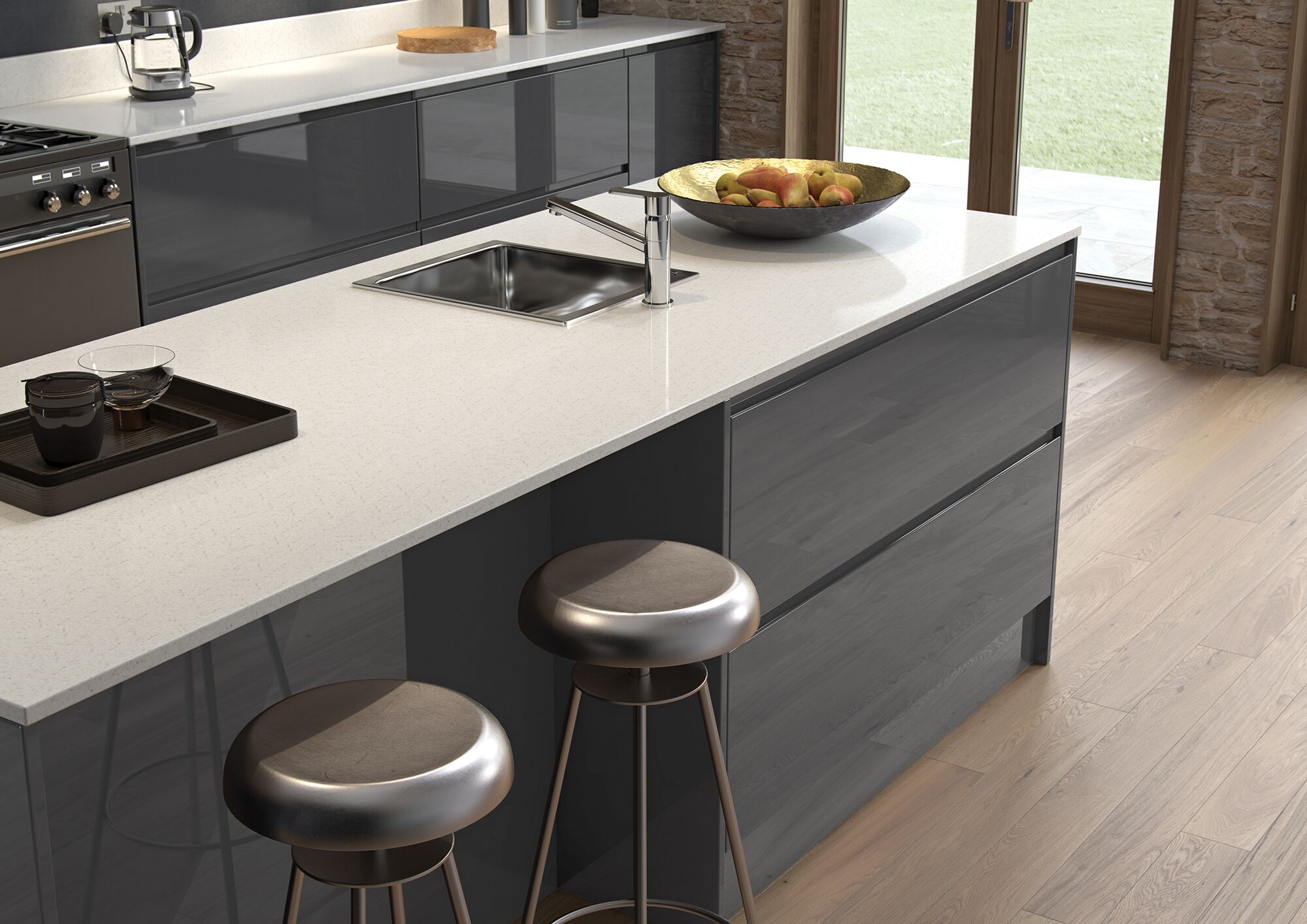
Choose a worktop by looking at what will happen on it every day: chopping, preparing food, putting down pans, cleaning up and living with joins around sinks and corners. Colour matters, but a small sample cannot show every fitted detail.
There is no single “best” material. Laminate, timber, engineered quartz and porcelain or sintered stone make different demands around edges, joints and maintenance. Compare specific products against your own habits.
What each name means in practice
Laminate is a decorative surface bonded to a supporting core. It comes in many colours and patterns, including finishes that imitate stone or wood. Ask to see a full-size edge and the proposed joint detail, particularly near the sink. The quality of fabrication and sealing matters to how those vulnerable areas cope with daily moisture.
Timber brings natural grain and warmth. Its appearance changes with use, light and the finish applied. Some timber surfaces are designed to be renewed, but the appropriate method and frequency depend on the product and its finish. Ask for the actual care instructions, especially for the area around the sink, rather than assuming every wooden worktop needs the same treatment.
Engineered quartz generally combines mineral content with a binder to form a manufactured slab. It is often chosen for a consistent appearance across a broad surface, though colours and patterns vary by range. “Quartz” is not a promise that every product has identical heat, stain or impact performance. Check the named product’s instructions and warranty conditions.
Porcelain and sintered-stone slabs are manufactured mineral-based surfaces, but the terms cover different brands and production methods. Look at the edge profile, any printed pattern and how corners, sinks and seams will be fabricated. Ask for guidance for the exact slab proposed.
Compare the finished layout, not four small swatches
Look at a large sample beside the chosen cabinet front, floor and wall colours in daylight and evening light. A patterned surface may look different over a long run; a quiet one may emphasise the join between sections.
Request a drawing that marks every joint, cut-out, upstand and visible edge. If the plan includes an undermounted sink, drainage grooves or a thin-looking profile, confirm that the named material and fabricator can deliver that detail.
Think about the first five minutes after dinner
Imagine wiping up a spill, moving a hot tray and cleaning around the tap. Will you be comfortable using a board for cutting and a trivet for hot cookware? Those are sensible habits with any worktop. They also help avoid relying on broad claims such as “heatproof” or “stainproof”, which may not match the product’s written guidance.
Decide whether you like a surface that develops character and may need periodic care, or prefer a more uniform look with different precautions. You might use timber on one section and another material around the sink; discuss the junction before ordering.
Cleaning guidance varies. Keep the supplier’s product sheet and ask which cleaners or treatments are recommended and which should be avoided. Check claims for the specified product, not a generic category.
Questions to settle before ordering
- What is the exact product, finish and thickness proposed?
- Where will the joints, visible edges and cut-outs be?
- Who measures, fabricates, delivers and fits the surface?
- What care instructions and warranty terms apply to this product?
- Is the quoted amount for the complete finished layout, including agreed extras?
Compare the worktop as part of the room. The modern kitchen gallery and bespoke kitchen gallery show different pairings of furniture and surface. If you are collecting estimates, the quote comparison guide helps you check that each includes the same worktop details.
Ready to compare specifications? Use the kitchen quote checklist.
Product care guidance
Care requirements vary by product. For examples of manufacturer-specific advice, see Silestone maintenance guidance and Dekton maintenance guidance. Check the instructions for the exact surface you choose.
Prepared with AI assistance for Kitchen Design. This is general planning guidance, not an installation specification.